
1948 THE PRODUCTION START
Therefore it was decided to start a small series of "SINGLESHAFT" not strictly similar to the base model, leaving some possibilities for a different look and performance.
N.20 motorbikes were assembled before the spring of 1947,
built with a craftsman system, with customization's possibility.
A really very SPECIAL PRODUCT.
Giovanni never forgot that racing is a great commercial launching pad, and his hopes were rewarded at the first important
race.
One of those motorbikes found place in the "1947 Golden Book of Results" with an INTERNATIONAL VICTORY at the
Lugano's Circuit (CH) by EZIO BERNASCONI, Swiss rider. The history tell us that the "Singleshaft" motorbikes
contributed very much to liven up competitions at the end of the 40s, with many victories:
1947 n.1 race, 1948 n.20 races, 1949 n.31 races, 1949 n.54 races
In the meantime, the Parilla family increased. On July 21st, 1948 Amorina gave birth to a child named Achille.
THE 250cc TWINSHAFT
Giovanni entrusted the project for the development of "TWINSHAFT" 250cc. 4-stroke to a top
designer (LUIGI SALMAGGI).
The same crankcase and the vertical transmission is still by small shaft with double bevel,
as the "Singleshaft". A new cylinder and head were designed, adding to the head a strong castle for the shafts'
rotations through a series of light gears. The bigger diameter valves are recalled by external double needle springs.
The four speed gearbox was the same as the "Singleshaft".
The frame was a little modified, both the shape and the size.
Changed also the angle of the rear shock absorber's case. To lighten the motorbike it was decided to make a lighter aluminum oil tank,
smaller and longer, but first of all lighter. The bore and the stroke remained the same, mm.66x72.
The Twinshaft head allowed the achievement of a more powerful valves' timing. The wider valves' size allowed a richer gas inlet,
the compression ratio up to 8:1. All those changes enabled the engine to supply nearly HP31 at rpm 8.500 and a top speed of Km/h 170.
Those excellent performances persuaded Giovanni to enter the motorbike at MONZA GRAND PRIX on October 23rd, 1948,
ridden by UMBERTO BRAGA from Mantova. No story about the race: Braga took the first position at lap 4,
leading the race for 32 laps (Km 201.6) in 1h29'29'' at an average speed of Km/h 135,17.
GIOVANNI, responding to an interview of a reporter who was pointing out the general discontent about the motorbikes' sales,
which were not enough compared to the purchase request, replayed about his plans as follows:
"Isn't in the intention of my Company to take care of the quantity of needed sales, if it will prejudice the high quality
we want to keep in any motorbike we produce. Our finality is to give our Customers the product they want, aware of buying
a very exclusive one"
.
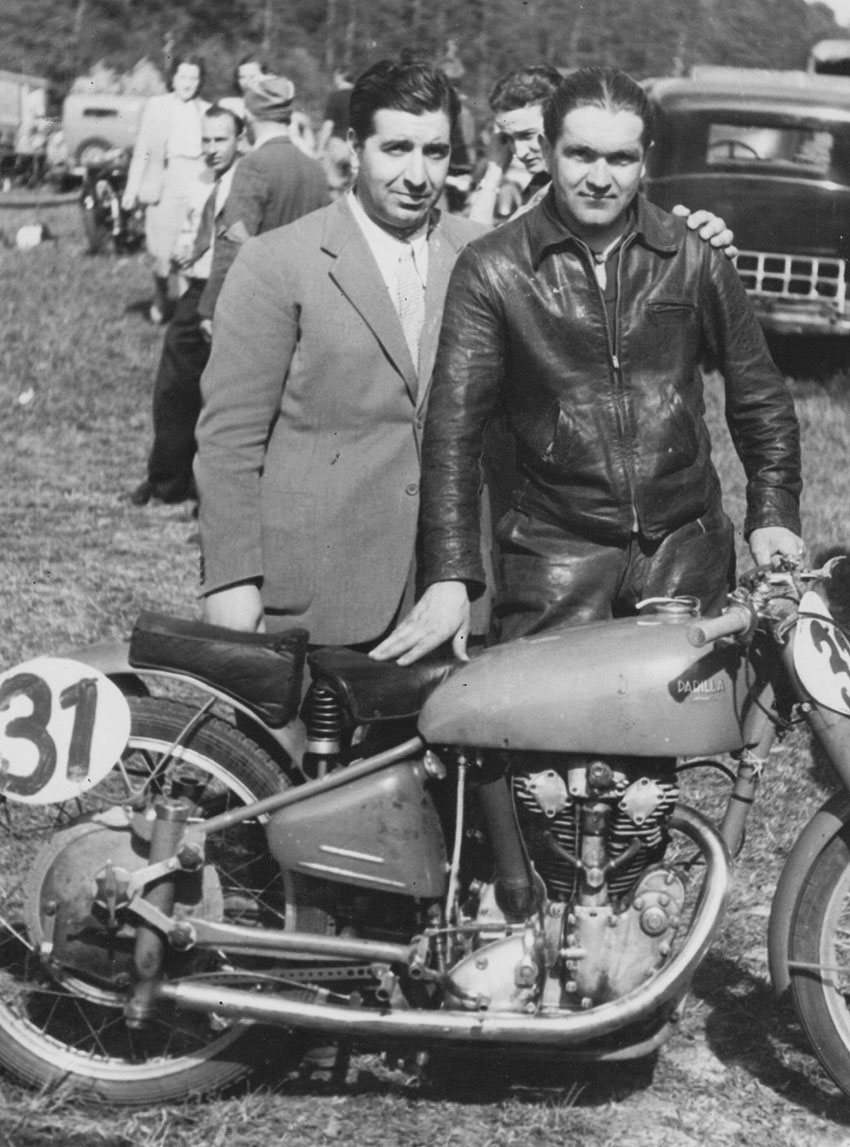
Giovanni and Celeste Cavaciuti, 1948
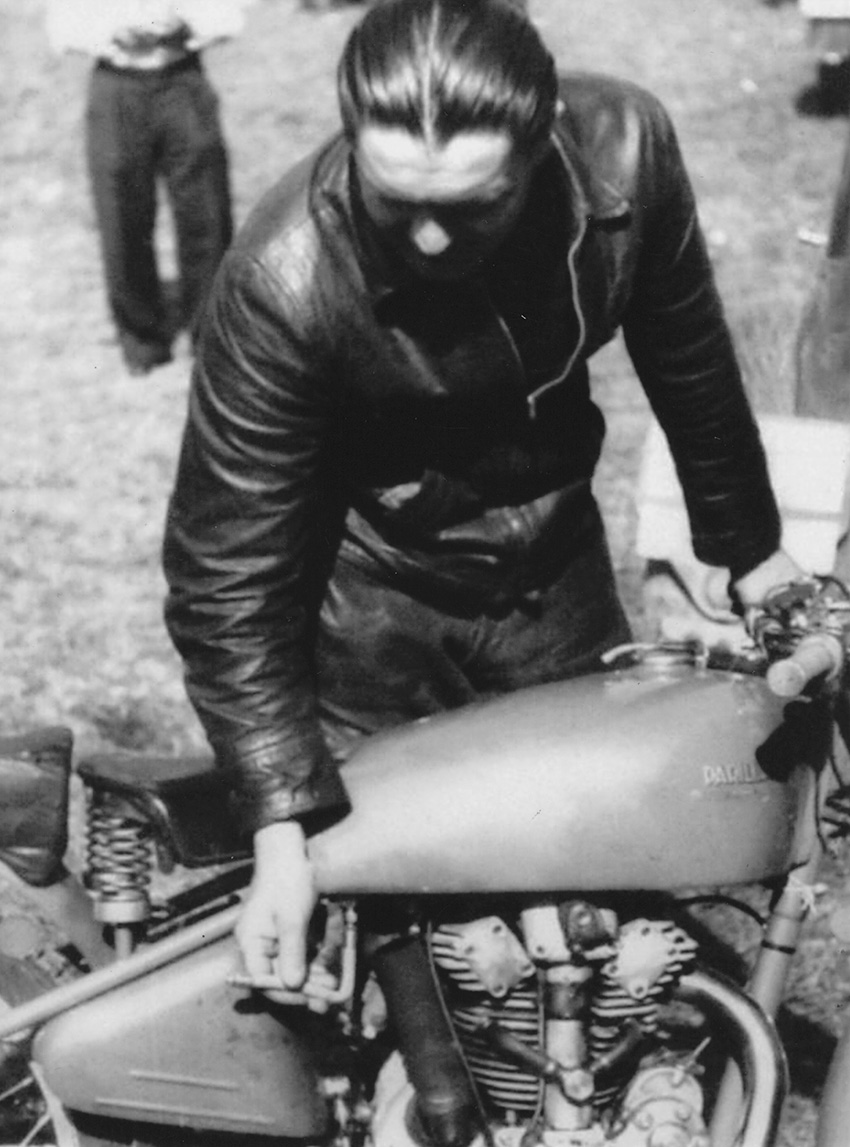
Celeste Cavaciuti, 1948